Georgette's home
"Brewery Dewaele"
A life between the farm, the war and the brewery
‘You have to try to get along, you know. That’s the stupidest thing you can have: a war.’
The project of the Brewery Dewaele started as a property memoir project. Somebody who knew me through my Urbex explorations and my fascination with abandoned locations gave my contact to a friend whose family was in the process of selling their estate somewhere North, near the coast, in the country side of West Vlaanderen. As Emiel Spriet (the youngest son of then six children) told me when we first met "We are selling our mother's house". Georgette Marie De Leye, 95 years old, was too old to tend to the large dominion on her won. It had been already a few months that she entered the elderly home in Gistel, all the while the children were looking for the right buyer for their property. In fact Georgette's house was not a common "onroerend erfgoed", as it was (and still is) part of the common heritage of Belgium. Already indicated on the original land registry map of 1835, the "Brouwerij Dewaele" remained active through the Second World War, only to be closed in 1960. At the time located in Westkerke, Georgette and her husband Maurice Spriet purchased the property in the December 1968 from Dewaele's grand daughter Marie Louise Dewaele. Georgette and Maurice had recently lost their farm to the industrialisation the region was undergoing following the economic boom of the post war. That property was their new project. The new home for their big family.
Forward to the year 2024...and so the story goes, that in front of the high renovation and maintenance costs, House Spriet-De Leye, previously known as Brouwerij Dewaele, a property safeguarding within its walls memories of entrepreneurship and business, of love and laughter, of hardships and growth, of loss and achievements...was finally - or shall I say again - looking for a new owner.
"But the house was still there, with its high tower, its chimneys, its marble stairs, its floors and that beautiful wrought-iron door. When the weather was fine and there was not much wind, I opened that door."

But little I knew, I was starting a journey into the life of a woman I would come to love with deep affection and admiration. A woman from another generation, a generation that was born in the decade after the first World War (1914-1918), growing through the Great Depression into the children and teenagers who would face the Nazi occupation of their own land during the horrors of World War II. Georgette's generation is known as the "silent generation" or "builders generation": the physical ruin and severe rationing of food and resources they experienced during their formative years turned them into highly resilient, disciplined, community-oriented people who knew true hard work, sacrifice and humility and who purposed their lives to the reconstruction of what was lost. This woman touched my heart from the very moment I met her. The simplicity and the kindness I saw in her eyes, told me stories of loss and emotional fatigue, but also reminded me of all I most value in a person. The capacity to transform trauma and difficulties into dedication, discipline, personal integrity, and gentle wisdom.
I knew Georgette cultivated through her decades the wisdom of what truly matters. The Family. The Home. Safety.

"My name is Georgette De Leye — De Leye, written with two capital letters. I was born in Ettelgem, on the twenty-ninth day of the sixth month of 1929. Twice 29. Ettelgem, that was a little parish, a little country parish."
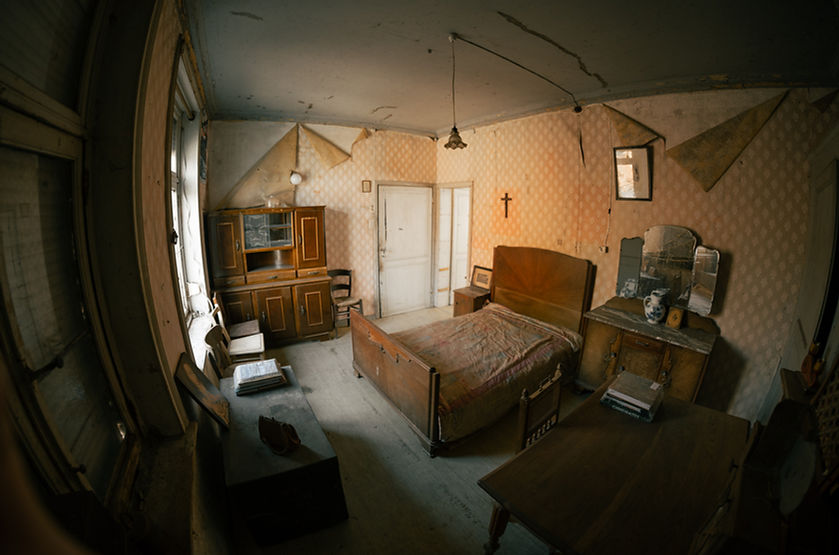
Finally at the beginning of the summer of 2024 I was granted access to the house right before the sale act was signed. I roamed with my camera and tripod around the house, enchanted by the beauty of its rooms: the furnitures from the years 50ies till 70ies were lying on marble, wooden or tiles floors dating back to the mid-to-late 1800 overcasted by ceilings that once upon a time must have been impeccable and extremely curated in their frescos. Each area of the house had a very specific colour palette, as if each room was to inspire a specific feeling to those lingering in its spaces. Objects of a random origin and precious furniture ranging from rococo to art deco, hinted to the reality of the families that inhabited it before Georgette and her belated husband could purchase it in the 50ies.


Above left: Georgette's pensive look captured on the video during our first interview.
video credit: Aubane Filée
Above right: Emiel is posing for me during my first visit to the estate. He is never without his loyal companion Irma.
Left and here below: the dining room located at the front of the house. The ceiling was decorated by a delicate fresco-like painting depicting tree Cupids, the god of love, passion and desire.

The more I captured those rooms with my lens, the more I became connected to Georgette and her family.
How was Georgette feeling about this major change, about the selling of her life's work and effort? How were her children and grandchildren going to keep this part of their family history alive in their memory. I felt honoured to be commissioned with such task. I realised that the pictures alone would be too silent, too immobile to deliver all the stories that were hidden behind every detail that captured my eye. I then decided to ask Emiel, her youngest son and my direct contact with the project, to ask Georgette whether she would agree to be interviewed by me. To my delight, Georgette did agree.
What you find in this page are extracts from the full photographic reportage (and book) and interview. These are the memories, thoughts and feelings shared during two hours of intimate recount between a curious Italian photographer and Georgette De Leye, the daughter, the wife, the mother and grandmother. With this digital heirloom I wish to repay her trust and that of her children in sharing with me their family story.
And to give YOU a glimpse of what could one day be YOUR OWN family digital heirloom.


"It was a large house for a large family. There was a bedroom for the girls and a bedroom for the boys. More boys slept behind that, and behind them was my bedroom. They once came to see whether everything was in order. The beds had not been made yet and then it got talked about at school. But there you are: first you had to do the land, then make the food and look after the children. There was a great deal of work in that.
I had too much work. The children sometimes went to the holiday colony by the sea because I could not manage it all. I paid membership dues to that Catholic Family Association, thinking: perhaps they will invite the children who have no father to come and play with the other children. But they never did. Never. And that is why I stopped paying."


"There were still bottles from the old days, bottles with the name of the brewery and Klemskerke or Westkerke pressed into the glass. You do not have that any more. They take everything away nowadays. But the house was still there, with its high tower, its chimneys, its marble stairs, its floors and that beautiful wrought-iron door. When the weather was fine and there was not much wind, I opened that door."


"In that photograph there is a little boy. My little boy. He died when he was ten. I needed him so much for the work on the farm, and he was still so young. My husband did not look after his dairy cows properly. I gave my boys a lot of milk instead of coffee; I am not one for coffee. But that milk was not always good. All of that had to be cleaned properly, at the proper time.
I had a family helper then to help me. ‘Be quiet,’ she said to my little boy, ‘so that your mother can work,’ while he laid there dying. A thing like that cannot be right. Damn it."
